Thanks everyone for another great term. We now have two weeks break. Term 4 starts Monday September 30.
Term 3 end
We have one more week of classes for term 3 and then two weeks break.
Term 4 begins on Monday September 30.
There is no grading this term. The next opportunity for grading will be in term 4.
Belts and Gradings??
Do we need belts and gradings?
With our upcoming Black Belt grading I want to discuss the topic of belts and gradings in terms of their history, importance and some issues they raise.
Firstly, I’m not about to cancel gradings. There are aspects of belts and grading I like as well as some downsides.
The idea of belts and grading in Karate shares the same origin as the karategi or uniform. Judo. As I mentioned in my post about uniforms, Judo was popular in Japan at the time Karate was finding its place. Along with adopting the Judo attire, the Judo belt system was also integrated into Karate in order to appeal to a wider audience. Backing up a little, to begin with Judo had just white belts and black belts for senior/advanced students. Later the coloured belts for kyu grades were introduced.
So already we can see that grading and belts are not particularly traditional to Karate, but a modern addition (around 1930’s).
Originally, people just trained Karate for the sake of learning and improving. If you were highly skilled, people could see that.
In our modern society, clear goals with rewards are popular. There is no doubt that the idea of earning a black belt has encouraged many students to keep training and put in extra effort to get there. I know I did. For two years leading up to my black belt test I practiced every day. I can’t say that I would have done that without the goal of black belt in mind. The extra effort ensured I was ready for my test but a more important result was that my skills improved greatly.
Now some of the problems with belts and grading. It is very difficult to have a standardized test that is fair to all. By now you know that I try to be flexible and accommodate differences. When it comes to black belt a certain standard is expected by the broader Karate community so I feel it is important to uphold that standard while trying to give everyone a chance.
Some people tend to get fixated on the belts, just wanting the next one without really understanding that the purpose of training isn’t belts but improving skills.
I think the biggest issue with grading and in particular black belt is that it is sometimes seen as an end goal. Many people achieve black belt only to stop training. There is a saying “black belt is just the beginning”. This couldn’t be more true. While it takes many years to reach black belt, it is far from mastery of the art. A black belt Karteka has a strong grasp on the basic skills and principles. Enough to begin to unlock deeper levels of understanding should they continue. It’s hard to imagine beforehand but I know in the years following my black belt test I began to realise how true this statement is. That’s not to say a black belt is worthless. Anyone who reaches this level is certainly skilled and reasonably well equipped to protect themselves and others and should receive recognition for their many years of training.
The true reward for training is an improved self. A belt to show for it is nice but without the belt, your skills remain and that’s all that really matters.
Grading will always be optional within Enso Karate. For some the idea of a new belts is motivating and that’s great. For some, gradings present a challenge to overcome and it pushes them further. For others it is a stressful idea and does not encourage greater effort. Students can choose to grade or not to grade. Those that choose to grade can expect to be challenged the higher they go. Black Belt will not be easy but it will be rewarding. Those that choose not to grade may need to find other ways to stay motivated but ultimately will discover that over time they will improve in many ways and this is the true purpose of Karate.
Thanks for reading.
Karategi or Uniform or Not
Karategi or Uniform
I’ve seen many posts recently on social media about wearing a white karategi or uniform and how it is essential as it is traditional, respectful and pure. This is simply not true.
I will never enforce wearing a so called “traditional” Karategi, gi or uniform for several reasons.
Firstly, I want all students to feel comfortable and confident in what they wear to training. Some people have sensory difficulties with certain fabrics, loose clothing or tight clothing. Some people have temperature differences and like minimal clothing or extra clothing. As long as students are comfortable and can train without restrictions, they can wear whatever they want. (Make sure you can squat. Loose or stretchy pants of some sort are best.)
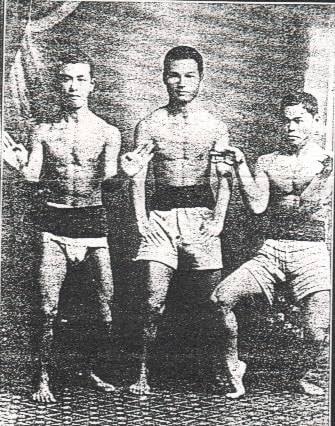
Secondly, the white karategi or uniform that many people are familiar with is not particularly traditional. Traditionally, in Okinawa, the birthplace of Karate, people would train in basic clothing such as shorts or what we might consider underwear (see image). It is a hot place and training in long clothing was not particularly practical.
Thirdly, cost. I won’t enforce buying a specific uniform. Students pay for class and that is enough. You don’t need to buy specific clothes to practice Karate.
Some people like to wear the uniform. I do. Sometimes. Usually black. It’s more practical than white in terms of keeping it looking clean. At home I mostly practice in shorts and T-shirt. For class I like to wear the karategi for a few reasons. It has some practical benefits. It is durable and can stand up to grappling techniques without tearing. It also helps to put me in the right mindset for training. When I put my uniform on I am preparing to train or teach. If a student finds value in wearing it that’s great. If not that fine.
So where does the karategi come from? It comes from Judo, a Japanese martial art/sport derived from Jujutsu. The Judo uniform was based on traditional Japanese clothing but with thicker fabric for durability (they do lots of throws by grabbing the jacket). Judo was very popular at the time Karate came to Japan and so the Karate schools adopted the Judo attire to try to keep up with trends and attract more people to Karate. It was white (in fact just unbleached cotton) because that was cheap. The Japanese version of Karate became popular around the world and the white uniform became associated with it. This was only around the 1930 onward so it still less than 100 years ago and can be considered a modern addition to Karate.
If you like the white karategi, wear it, but understand its history. If not, don’t. Wear what you feel comfortable and confident in. You will not be judged at Enso Karate.
Thanks for reading if you made it this far. 🙂 Coming soon: Do we need belts and grading?
Strengths and Challenges
Strengths and Challenges
This week in class we worked on identifying individual strengths and challenges.
Each student was asked to identify an aspect of karate training that they consider to be their strength and something that is challenging for them.
Generally strengths will be something that we enjoy or find come to us naturally. People will often practice these things more as it feels good to do well at something.
Challenges obviously are things we find harder or don’t come naturally to us and as a result we tend to neglect these aspects of training. (Some may call them weaknesses but I don’t like that. They are just things that need more practice.)
It is important to continue to build up our strengths to make them even better. Over time as a student progresses, they will begin to develop their own unique style and their strengths will be the foundation of this.
At the same time we need to ensure we work on improving the things we find challenging to bring them closer to the level of our strengths. Balance is essential.
Some examples of things students chose as strengths were:
Kata
Sparring
Kicks
Grappling
Some challenges were:
Push-ups
Speed and stamina
Kata
High kicks and jump kicks
We did some work on both strengths and challenges during class.
I request that all students practice their challenging aspect a couple of times during the week before next class. I will have questions about it.
If anyone missed class this week, have a think about your strengths and challenges and practice both.
Tuesday class ending.
Please be advised that the Tuesday night class will not be continuing from today. Remaining classes are:
Monday Harrisville 4:30-5-30pm
Wednesday Ipswich 10-11am
Thank you.
Uniform order
Uniform order. $40 each.
If anyone would like to order a uniform, please let me know by Wednesday 5pm. Comment, message or email. I need student height and colour preference: black, white, or black pants white top.
As always, karetegi (uniforms) are optional at Enso Karate. Students may train in any appropriate clothes that they feel comfortable in. The benefits of the karategi are that it is durable and allows full range of movement. Also and more importantly, when you put on your karategi you are preparing yourself to train. It helps to transition from other activities and put you in the state of mind required for training.
If there’s any other gear you’re after, gloves, protective equipment etc, let me know and I’ll have a look at options.
Path to Black Belt Training Journal
The Black Belt in Karate is a significant milestone. While it is far from mastery, it indicates a Karateka’s dedication and proficiency in Karate.
Prospective Black Belt students (1st kyu) will receive a Path to Black Belt Training Journal. Achieving Black Belt requires dedication, hard work and self-guided training. To be eligible for the Black Belt test students will be required to record additional training in this journal. If this is not suitable for any individual we can discuss alternatives. The content of the journal must include frequent training logs (date of training, duration and some notes on content practiced) and may also include current goals (learn a kata, increase push-ups, stretch more, start leaning Japanese terminology etc), any questions they may have to ask me or research themselves, general fitness training, notes on theoretical study of Karate history, techniques and anything else they find relevant to their journey.
I will be periodically checking training journals (students should bring them to every class) and giving feedback on frequency and content of the training. The journal will help to keep students on track, identify strengths and areas that need more work and let students see their progress and reflect on their journey. An invitation to test for Black Belt will be given only to those who show their commitment.
Term 3
Welcome to Term 3 everyone.
I hope all have had a nice break and are ready to train hard.
A few things to note…
Wednesday will be grading for Bella and Damara after previously being delayed.
Reminder that Wednesday class is now at the North Ipswich Scout Hall.
8A Smith St North Ipswich. I’ll have a sign on the railing to make it more visible.
As several students approach black belt, more advanced levels of sparring will be incorporated into their training. For safety, all students on brown belt and up will require a mouthguard for sparring. Standard boil and bite style mouthguards are suitable. These can be purchased from many chemists, sport stores or online. Let me know if you need assistance with this. Below brown belt do not require a mouthguard but are welcome to use one.
If anyone would like to order any gear such as uniforms, gloves or shin pads please let me know.
Please ensure term fees are paid as soon as possible. If you need to pay over time that’s fine, please just let me know.
All class times:
Monday Harrisville 4:30-5:30pm
Tuesday Ipswich 6:15-7:15pm
Wednesday Ipswich 10-11am
Saturday Private Dojo 2-3pm
Every day is an opportunity to improve ourselves. Think about why you train Karate. There can be many different reasons. What is yours? Identify your goals and the path will become clearer.
Always keep our Dojo Kun in mind:
Respect, Effort, Courage, Kindness.
Term 3
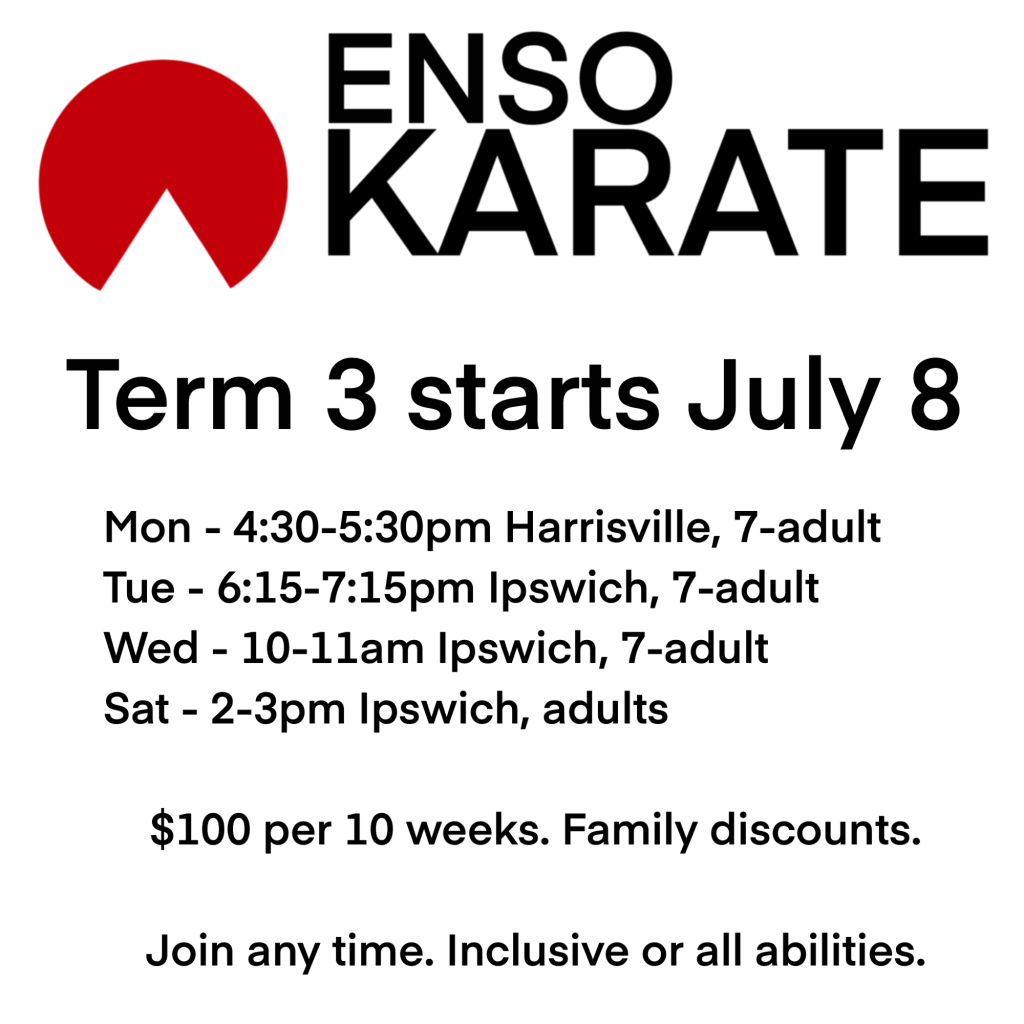
Mon – 4:30-5:30pm Harrisville, 7-adult
Tue – 6:15-7:15pm Ipswich, 7-adult
Wed – 10-11am Ipswich, 7-adult
Sat – 2-3pm Ipswich, adults
$100 per 10 weeks. Family discounts.
Join any time. Inclusive or all abilities.
 Enso Karate