

Karategi or Uniform
I’ve seen many posts recently on social media about wearing a white karategi or uniform and how it is essential as it is traditional, respectful and pure. This is simply not true.
I will never enforce wearing a so called “traditional” Karategi, gi or uniform for several reasons.
Firstly, I want all students to feel comfortable and confident in what they wear to training. Some people have sensory difficulties with certain fabrics, loose clothing or tight clothing. Some people have temperature differences and like minimal clothing or extra clothing. As long as students are comfortable and can train without restrictions, they can wear whatever they want. (Make sure you can squat. Loose or stretchy pants of some sort are best.)
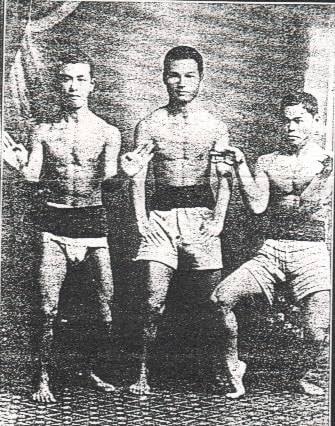
Secondly, the white karategi or uniform that many people are familiar with is not particularly traditional. Traditionally, in Okinawa, the birthplace of Karate, people would train in basic clothing such as shorts or what we might consider underwear (see image). It is a hot place and training in long clothing was not particularly practical.
Thirdly, cost. I won’t enforce buying a specific uniform. Students pay for class and that is enough. You don’t need to buy specific clothes to practice Karate.
Some people like to wear the uniform. I do. Sometimes. Usually black. It’s more practical than white in terms of keeping it looking clean. At home I mostly practice in shorts and T-shirt. For class I like to wear the karategi for a few reasons. It has some practical benefits. It is durable and can stand up to grappling techniques without tearing. It also helps to put me in the right mindset for training. When I put my uniform on I am preparing to train or teach. If a student finds value in wearing it that’s great. If not that fine.
So where does the karategi come from? It comes from Judo, a Japanese martial art/sport derived from Jujutsu. The Judo uniform was based on traditional Japanese clothing but with thicker fabric for durability (they do lots of throws by grabbing the jacket). Judo was very popular at the time Karate came to Japan and so the Karate schools adopted the Judo attire to try to keep up with trends and attract more people to Karate. It was white (in fact just unbleached cotton) because that was cheap. The Japanese version of Karate became popular around the world and the white uniform became associated with it. This was only around the 1930 onward so it still less than 100 years ago and can be considered a modern addition to Karate.
If you like the white karategi, wear it, but understand its history. If not, don’t. Wear what you feel comfortable and confident in. You will not be judged at Enso Karate.
Thanks for reading if you made it this far. 🙂 Coming soon: Do we need belts and grading?
 Enso Karate